
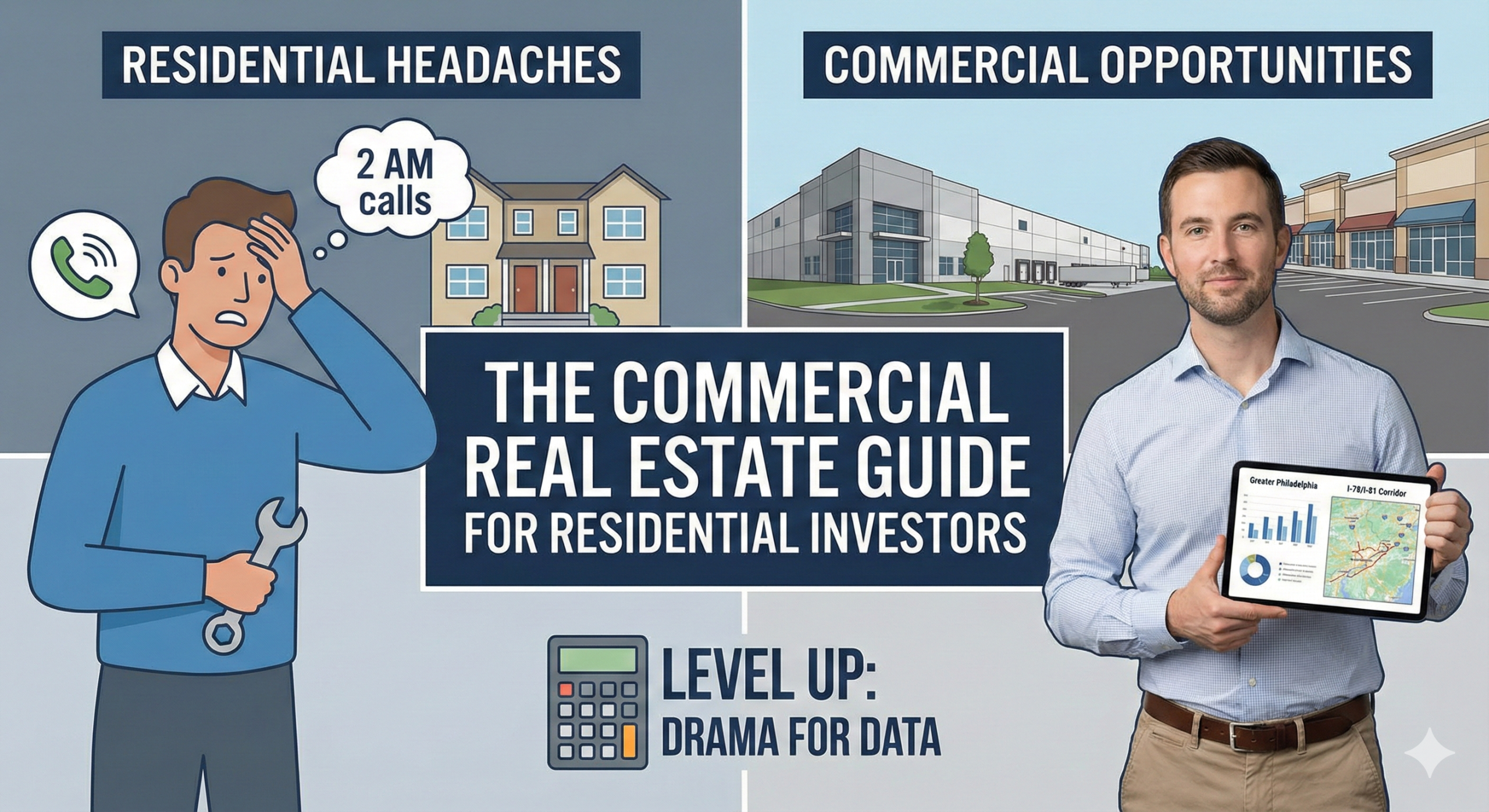
A candid guide for residential investors ready to level up—with Greater Philadelphia as your training ground
Let’s talk about that duplex you’re tired of managing
You know the one. The 2 AM phone calls about broken water heaters. The tenant who thinks “security deposit” means “free paint for my accent wall.”
What if I told you that same equity could control a $4M warehouse with an 8-year FedEx lease, zero midnight emergencies, and 260 basis points more cash flow?
Here’s the math that made me stop scrolling:
📊 Your typical Philly suburb duplex:
4.3% cap rate
📦 I-81 corridor industrial:
6.1% cap rate
🏪 Delco strip retail:
7.4% cap rate
Same equity. Wildly different outcomes.
Why 2025 is your window (and why Pennsylvania specifically)
Three things are happening right now:
1. The rate environment is stabilizing
Banks are quoting 5-year commercial loans at SOFR + 225-275bps. Not amazing, but predictable. SOFR forwards price in 75bps of cuts by Q4 2026, and lenders are finally offering 3-year mini-perms with reasonable prepay windows.
2. Bonus depreciation is going away
This is the last year for 100% bonus depreciation. After Jan 2026, it drops to 60%. If you’re doing any value-add work, that’s real money left on the table.
3. Pennsylvania is still underpriced
While everyone’s chasing deals in Atlanta and Phoenix, the I-78/I-81 corridor is trading 150-250bps above replacement cost. Translation: cushion for mistakes.
The real numbers (because Instagram gurus won’t show you these)
Here’s the Greater Philadelphia snapshot my team uses:
🏭 Industrial (Lehigh-Berks corridor)
- Vacancy: 3.2%
- Average rent: $6.92/SF NNN
- Cap rates: 5.5-6.0%
- 10-year rent growth: 3.4% annually
🏪 Neighborhood Strip Retail (Delaware County)
- Vacancy: 5.8%
- Average rent: $18.50/SF NNN
- Cap rates: 7.0-7.5%
- 10-year rent growth: 2.2% annually
🏢 Office (Center City)
- Vacancy: 18.4% 😬
- Skip this unless you love pain
The pattern? Industrial and retail still deliver positive leverage. Office is a trap unless you have a Fortune 500 tenant on a 10-year lease.
Four commercial assets you can actually manage
The secret nobody tells you: you already have the skills. You know how to screen tenants, manage vendors, and turn a wrench. Start with deals that use those skills.
1. Small Industrial (20-100k SF)
Think: Last-mile warehouses, HVAC contractors, auto repair shops
Why it works: Tenants sign 5-year leases with 5-year options, pay for everything (NNN), and don’t call you when their dishwasher breaks. Because there is no dishwasher.
Value-add moves:
- LED retrofit (5-year cost-seg)
- Dock-high conversion ($7k per dock)
- Fenced laydown yard ($12/SF)
2. Strip Retail with “Amazon-Proof” Tenants
Think: Dollar stores, nail salons, medical clinics, breweries
Why it works: You’re collecting $16-22/SF NNN from tenants who need physical locations. A 1,200 SF suite rents for ±$1,800/month—the same mental model as your row homes.
Red flag: Avoid centers where >25% of space goes to unproven restaurants. SBA lending has tightened, and restaurant failure rates are brutal.
3. Self-Storage (Converting Dead Big-Box)
Why it works: Philly MSA is at 92% occupancy. A 10×10 climate unit rents for $195/month. Conversion costs about $55/SF, and you’re cash-flow positive at 65% occupancy.
Bonus: CMBS lenders will give you 30-year non-recourse financing at 5.9%—almost impossible to find on small deals otherwise.
4. Mixed-Use (If You Want to Stay Adjacent to Multifamily)
Build 5-over-1 (apartments over retail), sell the retail condo to a 1031 buyer at completion, keep the apartments. You’re “graduating” into commercial construction while keeping your exit in familiar territory.
The financing toolkit that actually exists in late 2025
Forget what you read in 2021. Here’s what’s working now:
Option 1: Cross-Collateral Blanket Loan
Pledge 3-4 paid-off duplexes to hit 80% LTV on your commercial deal. Costs SOFR + 250bps, 5-year term. Works with regional banks under $20B in assets.
Option 2: SBA 504 Green Energy
Add solar panels generating >15% of the building’s power, and SBA bumps your loan from $5M to $5.5M. Blended rate today: 5.4% fixed for 25 years. Only 10% down.
Option 3: Master Lease with Option
Perfect for maxed-out DTI. Lease a vacant building at $12/SF, sublease at $18/SF, keep the spread. Exercise your purchase option on the next refi. Zero bank qualifying.
Option 4: Delaware Statutory Trust (DST)
Don’t want to manage? Drop your 1031 proceeds into a $50M+ DST that already owns Philly logistics. Minimum $250k. You still get depreciation and defer cap gains.
The due diligence checklist I wish I had
(The abbreviated version—I’ll send the full 30-item list to anyone who DMs me)
- ✅ Environmental Phase I within 180 days (PA has legacy industrial)
- ✅ Zoning confirmation (Philly Zoning Board backlog: 6-8 weeks)
- ✅ ADA lawsuit scan (drive-by filings still rampant in E.D. Pa)
- ✅ Tax assessment review (2025 raised industrial AVs by 18%)
- ✅ Last 3 years of CAM reconciliations
- ✅ Roof inspection if >15 years old (demand 1.5x replacement escrow)
- ✅ U&O certificate (Philly fines $300/day for lapses)
The tax tricks that survived into 2025
PA Realty Transfer Tax:
4.278% inside Philly, 2% outside. Structure as an LLC membership interest sale to save 2/3 of this.
Keystone Opportunity Zones:
Extensions granted through 2025 in Norristown, Chester, and parts of Berks County. That’s 0% state income and local NPT for 10 years.
Construction Tax Alert:
Philly added a new 1% tax on hard costs starting Jan 2025. Budget for it if you’re renovating >$750k.
What can still blow up (let’s be honest)
⚠️ Industrial rent growth has been running 8%/year. Underwrite 1%, stress test at -3%.
⚠️ Regional banks are getting cap-hammered by regulators. Your favorite community bank may not renew your line in 2026.
⚠️ Philly’s Eviction Diversion Program now covers commercial leases under 50k SF. Budget an extra 90 days of free rent for problem tenants.
⚠️ Property insurance is up 37% YoY in Philadelphia County due to arson claims. Triple your pro forma.
Your 90-day action plan
Weeks 1-2:
Pick your asset type (I vote small industrial). Get pre-qualified with 2 regional banks + 1 debt fund.
Weeks 3-6:
Subscribe to CoStar Lite ($199/month). Drive the I-78 corridor. Photograph buildings. Cold-call tenants. Build your own rent comps.
Weeks 7-10:
Submit an LOI. 50bps below ask, 30-day study period, 2% refundable earnest money. Order Phase I, survey, and roof inspection on day 1.
Weeks 11-13:
Close in a Wyoming LLC. File PTE election to pay 3.07% PA tax at entity level (federal SALT workaround).
The closing thought
Making the jump from residential to commercial isn’t about “getting bigger.” It’s about swapping drama for data.
If you can underwrite a duplex’s cash-on-cash return, you can underwrite a 40k SF warehouse. The math is identical. The leases just last ten times longer. And the tenants don’t call you at midnight because the microwave broke.
Because commercial buildings don’t have microwaves.
Pennsylvania—especially the I-78/I-81 spine and Philly’s last-mile nodes—still offers that 150-250bps cushion you can’t find in overheated markets. Use 2025’s rate plateau and the bonus depreciation sunset as your window.
Challenge yourself: submit three LOIs in the next 90 days.
The first one feels like jumping off a cliff. Until you realize commercial real estate comes with a parachute called Net Operating Income.
What’s holding you back from making the jump? Drop a comment—I read every one.
*Want the full 30-item due diligence checklist or my Pennsylvania market comp spreadsheet?*
DM me “COMMERCIAL” and I’ll send it over.
#CommercialRealEstate #RealEstateInvesting #Philadelphia #IndustrialRealEstate #CRE #RealEstate #PassiveIncome #WealthBuilding #PropertyInvestment #Pennsylvania