
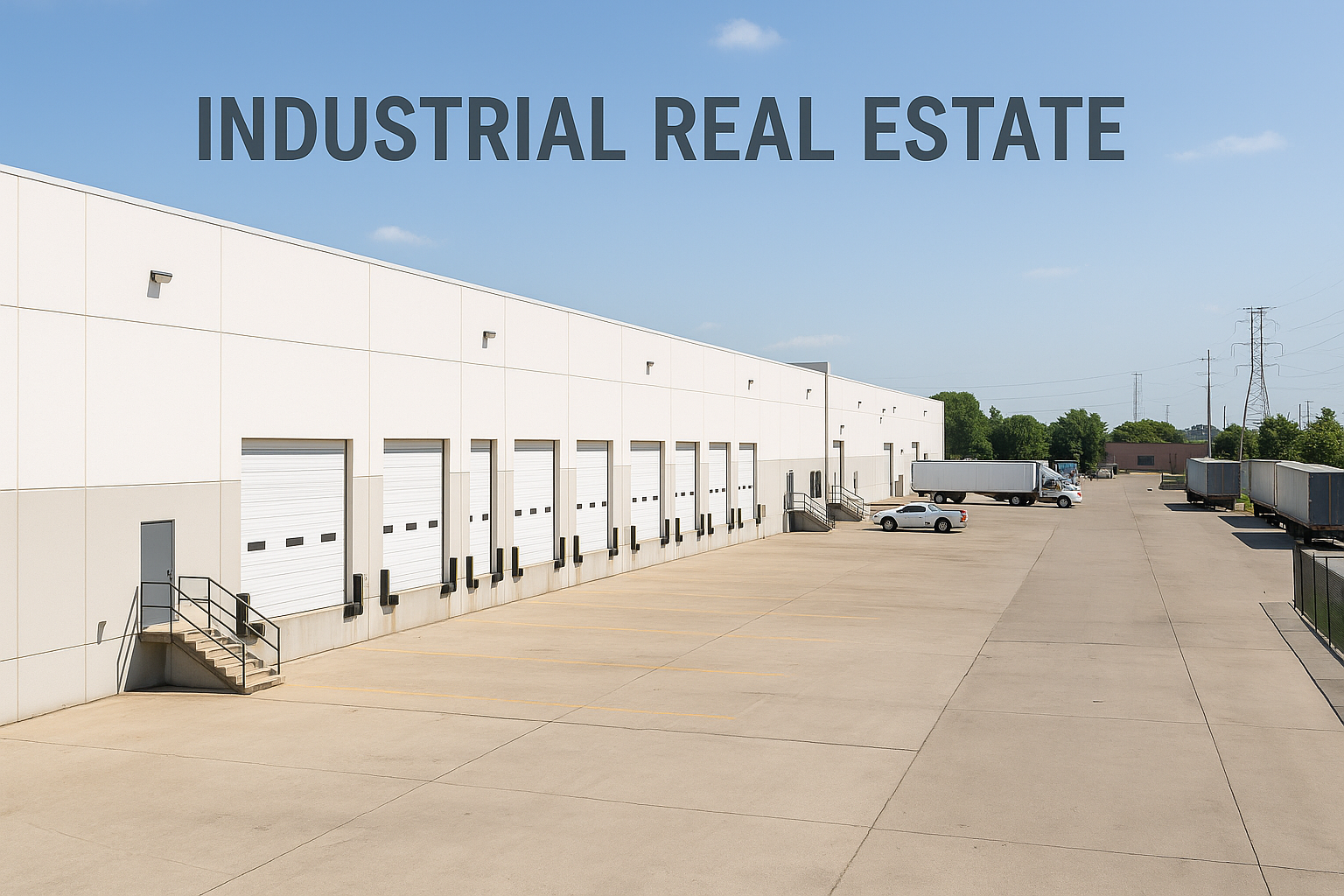
Industrial Property Steps Into the Spotlight
Once a niche within commercial real estate, industrial assets—warehouses, logistics hubs, flex and light manufacturing—have moved to the foreground. Investors are weighing these properties against retail centers and office towers amid shifting tenant demand, changing workplace patterns, and supply-chain rewiring.
📦 What Counts as Industrial
- Bulk distribution & logistics: regional and national warehouses.
- Last-mile/infill: smaller facilities near dense consumer areas.
- Manufacturing: light or heavy production space with specialized power and floor loads.
- Flex: hybrid office/warehouse or R&D suites.
- Specialized niches: cold storage, industrial outdoor storage; often adjacent categories include data centers and life-science production.
Note: Industrial, retail, and office are all subtypes of commercial real estate. The comparison here is industrial versus retail/office.
🔍 Why Industrial Behaves Differently
- E-commerce and omnichannel: Every gain in online sales expands fulfillment and last-mile needs—an advantage industrial has over many brick-and-mortar formats.
- Supply-chain shifts: Nearshoring, higher safety-stock levels, and intermodal hubs are reinforcing demand for well-located space.
- Utility over polish: Clear heights, dock doors, truck courts, and power capacity matter more than lobby finishes—broadening the tenant pool.
- Tenant stickiness: Once racking, conveyors, refrigeration, or production lines are installed, moves become costly, reducing turnover.
💰 Income Profile and Cost Structure
⚠️ Key Risks to Underwrite
- Functional obsolescence: Older specs—low clear heights, tight columns, shallow truck courts—can lag modern 32–40-foot clear product.
- Specialization risk: Cold storage and heavy manufacturing can command premiums, but shrink the re-tenanting universe and raise TI exposure.
- Cyclicality: Logistics tied to consumer delivery is resilient; manufacturing-linked demand is more rate- and cycle-sensitive.
- Environmental & zoning: Prior uses may trigger remediation; truck traffic and hours can face community and municipal limits.
📍 Location Economics
Freight math
Proximity to interstates, ports, rail and population density typically beats cosmetic upgrades.
Labor and incentives
For production, workforce depth and economic-development packages can outweigh rent differentials.
Infill scarcity vs. edge supply
Infill often benefits from entitlement barriers, while peripheral submarkets face new deliveries and competition.
🏭 Industrial vs. Retail
- Industrial tailwinds: E-commerce growth favors warehouses; tenant improvements are usually simpler; downtime can be shorter for well-located space.
- Retail realities: Street retail and grocery-anchored centers can outperform with strong merchandising—yet depend on traffic patterns and consumer behavior.
🏢 Industrial vs. Office
- Expense burden: Industrial landlords typically face lower ongoing cap-ex than office owners navigating amenities, TI/LCs, and re-positionings.
- Utilization risks: Hybrid work remains a headwind for many offices; industrial demand is tied more to goods movement than desk density.
🔎 Where Investors Are Finding an Edge
Small-/mid-bay last-mile
10–100k SF multi-tenant buildings near rooftops with diversified, sticky local users.
Yard-rich sites
Trailer and truck parking scarcity in many metros is becoming a competitive moat.
Industrial outdoor storage (IOS)
Low-coverage, zoning-sensitive sites with durable demand from logistics and construction trades.
Cold storage
Defensive but cap-ex heavy; credit and long terms are critical.
Flex/R&D
Concentrated near universities and hardware/biotech clusters; higher rent potential with higher TI and re-tenanting risk.
📊 Portfolio Role and Return Framing
Industrial often provides defensive, inflation-linked income via NNN structures and replacement-cost support in supply-constrained nodes. Initial yields compress for Class A infill with strong growth prospects, while specialized or peripheral assets price with higher going-in cap rates and wider underwriting cushions.
🛠️ Underwriting Checklist
| Category | Key Considerations |
|---|---|
| Market & site | Drive-time to population/highways/ports/rail; barriers to supply; circulation, trailer ratio, and parking. |
| Building specs | Clear height, column spacing, dock/drive-in mix, ESFR sprinklers, power, floor loads, roof condition. |
| Lease & tenant | Remaining term, rent steps, NNN recoveries, options; tenant credit; TI on renewal; downtime assumptions. |
| Capital plan & exit | Immediate repairs (roof, paving, lighting); efficiency upgrades (LED, solar readiness); demising options; buyer pool depth. |
| Legal & environmental | Phase I (and II if needed); zoning for truck counts/hours and outdoor storage; survey/easements. |
🏆 When Retail or Office Might Outperform
Retail
Grocery-anchored centers in undersupplied trade areas and prime experiential corridors can deliver strong results—but require active merchandising.
Office
Best-in-class buildings in tight submarkets tied to durable industries can command premium rents—if leasing risk and cap-ex are well managed.
✅ Bottom Line
For investors seeking steady, operationally straightforward cash flow, industrial stands out. The thesis is not risk-free—functionality, infill scarcity, and tenant credit still drive outcomes—but compared with many retail and office profiles, industrial generally offers cleaner NNN income, lower cap-ex drag, and structural support from how goods are produced, stored, and delivered.