

Philly vs. NYC Real Estate: A 2025 Investor’s Deep Dive into Two Urban Giants
New York, NY & Philadelphia, PA – The real estate landscapes of Philadelphia and New York City, two titans of the Northeast corridor, present investors with a classic clash of investment philosophies in 2025. While separated by a mere 90-minute train ride, the markets offer starkly different propositions: Philadelphia, the accessible engine of cash flow, versus New York City, the global bastion of long-term appreciation. This comprehensive analysis, enriched with current data, neighborhood-level case studies, and strategic insights, will dissect these two markets to guide investors in the current economic climate.
1. Affordability and Entry Costs: A Tale of Two Markets
The most significant chasm between the two cities lies in their price points. For many, this single factor will dictate their investment journey.
Philadelphia: The Accessible Contender
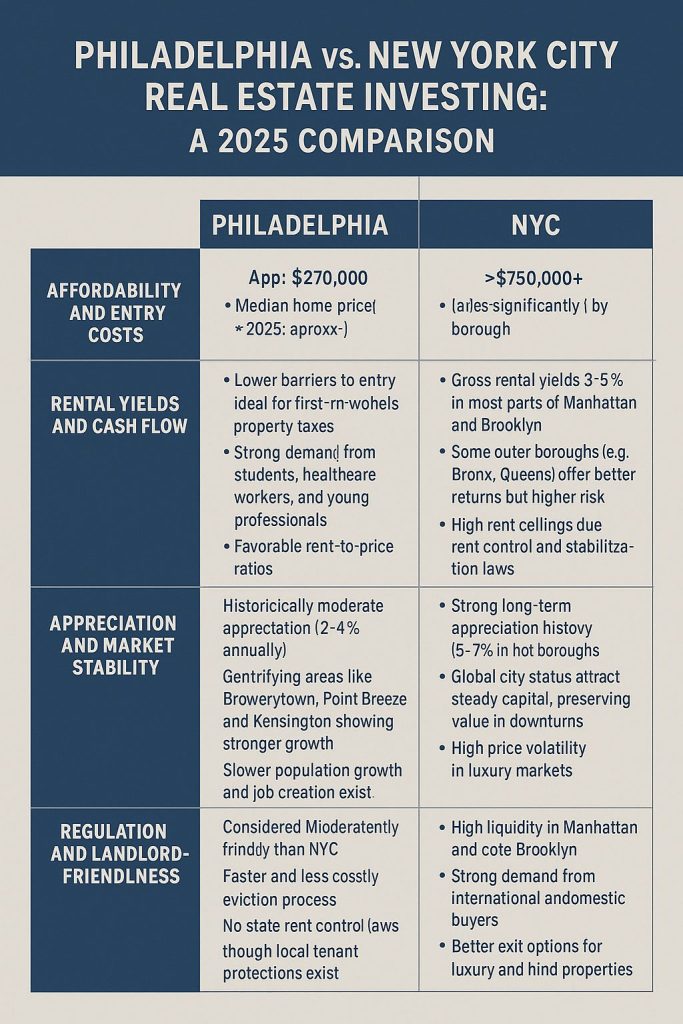
With a median home price hovering around $270,000 in 2025, Philadelphia remains a beacon of affordability on the East Coast. This lower barrier to entry is a powerful magnet for first-time investors, those with modest capital, and syndicators looking to acquire more doors for their dollar. Closing costs and property taxes are also notably lower than in the five boroughs.
Case Study: The Brewerytown Rowhome
An investor in 2025 could acquire a three-bedroom rowhome in a gentrifying neighborhood like Brewerytown for approximately $250,000. With a 20% down payment ($50,000) and an estimated $30,000 for renovations (new kitchen, updated baths, refinished floors), the total initial investment would be around $80,000. This type of property is a prime candidate for a “BRRRR” (Buy, Rehab, Rent, Refinance, Repeat) strategy, allowing for capital to be pulled out for the next investment.
New York City: The Heavyweight Champion
In stark contrast, New York City’s median home price sits at a formidable $750,000+, with significant variations across its boroughs. Manhattan’s median often crests $1.2 million, while the Bronx offers a more “accessible” entry point, though still significantly higher than Philadelphia. The high initial capital required often necessitates creative financing, partnerships, or a substantial personal war chest. Furthermore, the prevalence of co-ops, especially in Manhattan and parts of Brooklyn, introduces another layer of complexity with their stringent board approvals and often restrictive subletting policies.
2. Rental Yields and Cash Flow: Where Your Money Works Hardest
For investors prioritizing passive income, the rent-to-price ratio is a critical metric, and here, Philadelphia shines.
Philadelphia: The Cash Flow King
Gross rental yields in many of Philadelphia’s working-class and emerging neighborhoods, such as parts of West Philadelphia and South Philadelphia, can range from 6% to 9%. The city benefits from a diverse and stable tenant base, including a large student population from its numerous universities, healthcare professionals from its world-class hospital systems, and a growing contingent of young professionals.
Case Study: West Philadelphia Section 8 Play
An investor purchases a duplex in a stable section of West Philadelphia for $300,000. Each unit, a two-bedroom apartment, can command a Section 8 voucher rent of approximately $1,500 per month, totaling $3,000 in gross monthly rent. Even after accounting for higher management fees and potential vacancies associated with this strategy, the annual gross rental income of $36,000 on a $300,000 asset offers a robust return, often with the security of government-backed rent payments.
New York City: The Appreciation Play with Modest Yields
In most of Manhattan and prime Brooklyn, gross rental yields are compressed, typically falling between 3% and 5%. The city’s stringent rent stabilization laws, which apply to a significant portion of its housing stock, can cap rental growth and create a more tenant-friendly environment. While the outer boroughs, particularly the Bronx and parts of Queens, can offer higher yields, they often come with increased management intensity and property-level challenges.
3. Appreciation and Market Stability: The Long Game
While cash flow is king for some, others are willing to sacrifice immediate returns for the promise of long-term wealth creation through appreciation.
Philadelphia: Steady and Emerging Growth
Historically, Philadelphia has seen more moderate and sustainable appreciation, averaging 2-4% annually. However, in recent years, gentrifying neighborhoods like Fishtown, Point Breeze, and Kensington have witnessed more robust growth. The city’s economic development, particularly in the life sciences and tech sectors, is a promising indicator for future appreciation. The “eds and meds” economy provides a stable foundation, though population and job growth rates are slower than in NYC.
New York City: A Global Safe Haven for Capital
New York’s status as a global city provides a unique level of market stability. It attracts a steady flow of international and institutional capital, which helps to preserve value, even during economic downturns. Historically, prime NYC real estate has offered long-term appreciation in the 5-7% range annually. This makes it a powerful vehicle for wealth preservation and multi-generational equity building.
Case Study: A Long-Term Hold in Queens
An investor in 2025 acquires a two-family home in a transitioning Queens neighborhood like Jamaica for $850,000. While the initial cash flow might be minimal after debt service, the long-term play is based on the area’s ongoing redevelopment, infrastructure improvements, and its relative affordability within the NYC context. Over a 10-15 year hold period, the potential for significant appreciation is the primary driver of the investment thesis.
4. The Regulatory Landscape: Landlord vs. Tenant Rights
Philadelphia: A More Landlord-Friendly Environment
Generally considered more landlord-friendly than its northern neighbor, Philadelphia offers a faster and less costly eviction process. While the city has its own set of tenant protections, it is not subject to statewide rent control laws, giving landlords more flexibility in setting and adjusting rents.
New York City: A Tenant-Centric Jurisdiction
New York City is renowned for its robust tenant protections and strict rent regulation laws. The eviction process can be lengthy and complex, often favoring the tenant. The Housing Stability and Tenant Protection Act of 2019 further solidified these protections, making it a challenging environment for landlords who are not well-versed in the local laws. For investors, particularly those in the co-op and condo space, board regulations add another layer of governance that can limit rental activity.
5. Market Liquidity and Exit Strategies: Cashing Out
Philadelphia: A More Patient Market
The resale market in Philadelphia can be slower, particularly for properties in non-core or less gentrified neighborhoods. The pool of institutional buyers is smaller, and short-term “fix and flip” strategies can be more challenging outside of the hottest submarkets. A successful exit in Philadelphia often requires a well-maintained and competitively priced property.
New York City: High Liquidity in a Global Marketplace
The high-stakes world of New York City real estate offers a level of liquidity that is hard to match. The sheer volume of transactions and the diverse pool of buyers—from international high-net-worth individuals to large institutional funds—create a more dynamic and fluid market. This is especially true for prime properties in Manhattan and sought-after Brooklyn neighborhoods, providing investors with more reliable exit options.
The 2025 Investor Profile: Finding Your Fit
Philadelphia is the ideal market for:
- Cash-flow focused investors: Those seeking immediate and consistent passive income.
- Buy-and-hold landlords: Investors looking to build a portfolio of income-producing properties.
- Value-add and BRRRR strategists: Individuals who can capitalize on the city’s older housing stock through renovation.
- Investors with moderate capital: Those who are priced out of more expensive coastal markets.
New York City is the superior choice for:
- High-net-worth individuals and institutional investors: Those with the capital to compete in a high-cost market.
- Appreciation-driven players: Investors with a long-term horizon focused on equity growth.
- Wealth preservation strategists: Individuals looking to park capital in a historically stable and appreciating asset class.
- Investors with access to sophisticated financing: Those who can navigate complex deal structures and lending environments.
Final Verdict
In the landscape of 2025, with a backdrop of fluctuating interest rates and a cautious economic outlook, the choice between Philadelphia and New York City is more distinct than ever. Philadelphia emerges as the pragmatic choice for investors seeking robust cash flow, a lower cost of entry, and a more straightforward landlord experience. It is a market that rewards diligence and hands-on management with tangible monthly returns.
Conversely, New York City, despite its high barriers to entry and complex regulatory environment, remains an unparalleled engine for long-term wealth creation. For those with the requisite capital and a multi-decade perspective, the global appeal and historical resilience of NYC real estate offer a compelling case for appreciation that can be difficult to replicate elsewhere. The ultimate decision hinges on an investor’s individual financial capacity, risk tolerance, and overarching investment philosophy.