
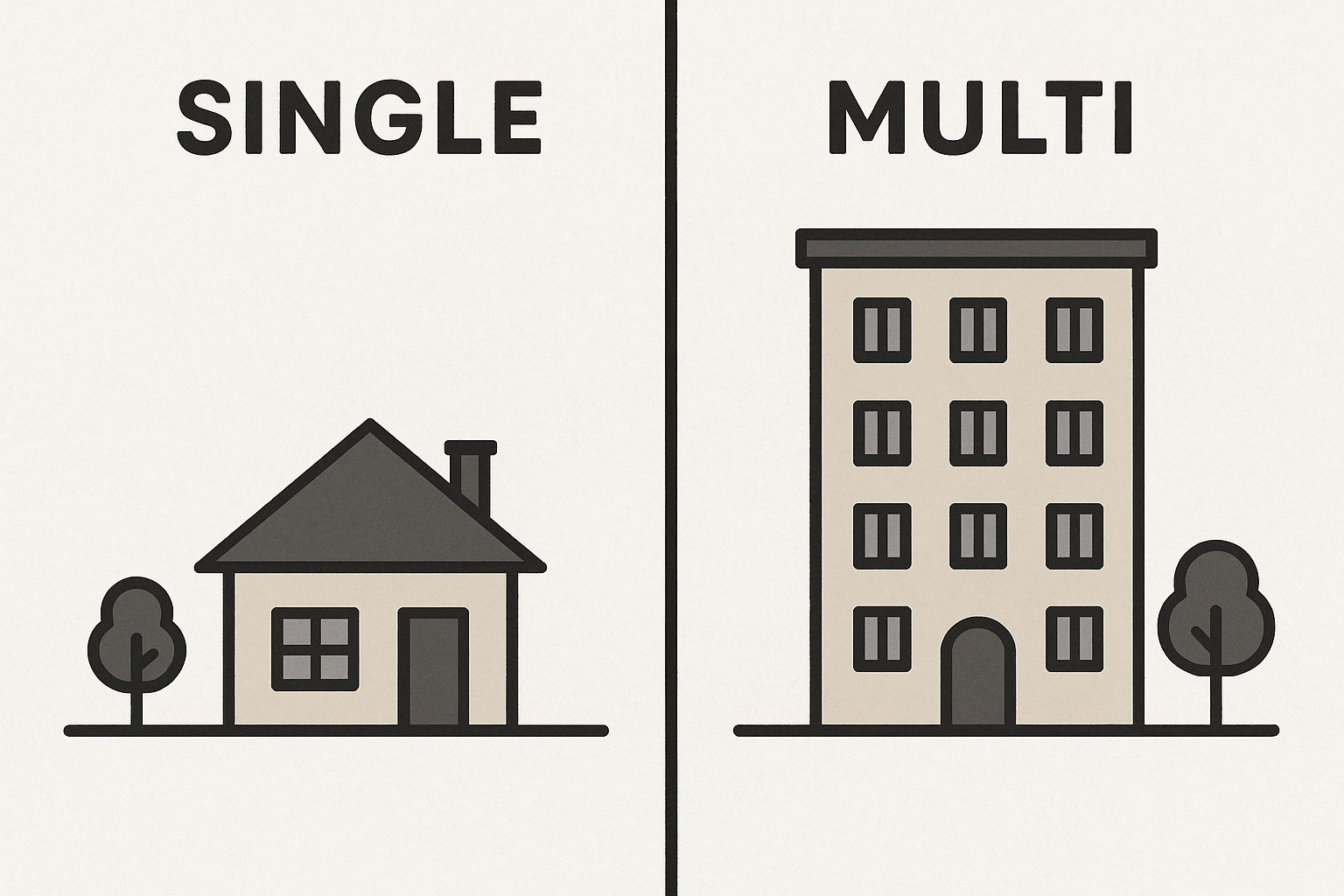
Single vs. Multi: Choosing Your Path in Residential Real Estate Investing
The allure of real estate investing is undeniable: tangible assets, potential cash flow, appreciation, and tax benefits. But one of the first decisions investors face is whether to focus on Single-Family Homes (SFHs) or Multi-Family Homes (MFHs). While both offer paths to wealth, their differences significantly impact strategy, risk, and returns.
Cash Flow & Income Potential
- SFHs: Lower per-unit cash flow. Income relies on one tenant—vacancy means 100% income loss for that property.
- MFHs: Stronger, more stable cash flow. Multiple units diversify risk (e.g., 1 vacancy in a 4-unit = 25% income loss). Economies of scale boost net income.
Financing & Entry Costs
- SFHs: Easier financing for beginners. Lower down payments (15-25%) and better interest rates.
- MFHs: Complex financing for 5+ units (classified as commercial). Requires 25-35%+ down payments and stricter underwriting (DSCR analysis).
Management & Operational Intensity
- SFHs: Simpler to self-manage initially. Scattered portfolios become logistically challenging.
- MFHs: Higher tenant turnover and shared systems increase management intensity. Professional management is often essential but more efficient at scale.
Risk & Diversification
- SFHs: Higher idiosyncratic risk—dependent on one tenant/location. Diversification requires multiple properties.
- MFHs: Built-in diversification. Multiple tenants spread risk of non-payment or vacancy within one asset.
Appreciation & Value Drivers
- SFHs: Value driven by comparable sales (“comps”) in the neighborhood. Renovations boost value.
- MFHs: Value driven by Net Operating Income (NOI). Formula: Value = NOI / Cap Rate. Increasing rent or cutting expenses directly increases value.
Economies of Scale
- SFHs: Limited economies of scale. Each property has separate costs (mortgage, taxes, maintenance).
- MFHs: Significant savings per unit. One roof, one tax bill, consolidated maintenance. Bulk renovations reduce costs.
Exit Strategies
- SFHs: Easier/faster sales to homebuyers or investors. Higher liquidity.
- MFHs: Longer sales process targeting investors. Requires thorough financial documentation but attracts institutional buyers.
Hybrid Option: The 2-4 Unit Multi-Family
Properties with 2-4 units offer a middle ground:
- Financed like SFHs (lower down payments)
- Enable “house hacking” (live in one unit, rent others)
- Multiple income streams with manageable scale
Which is Right For You?
- Choose SFHs if: You’re a beginner, have limited capital, prefer simple financing, or plan to self-manage.
- Choose MFHs (5+ units) if: You prioritize cash flow/scalability, have significant capital, and understand commercial financing.
- Choose Small Multis (2-4 units) if: You want diversification, house hacking options, and a stepping stone to larger investments.
The Bottom Line
There’s no universal “best” option. Your choice depends on financial resources, risk tolerance, goals, and expertise. SFHs offer accessibility but face scalability challenges. MFHs deliver powerful cash flow but require more capital and sophistication. Many successful investors build diversified portfolios using both strategies for balanced resilience.