
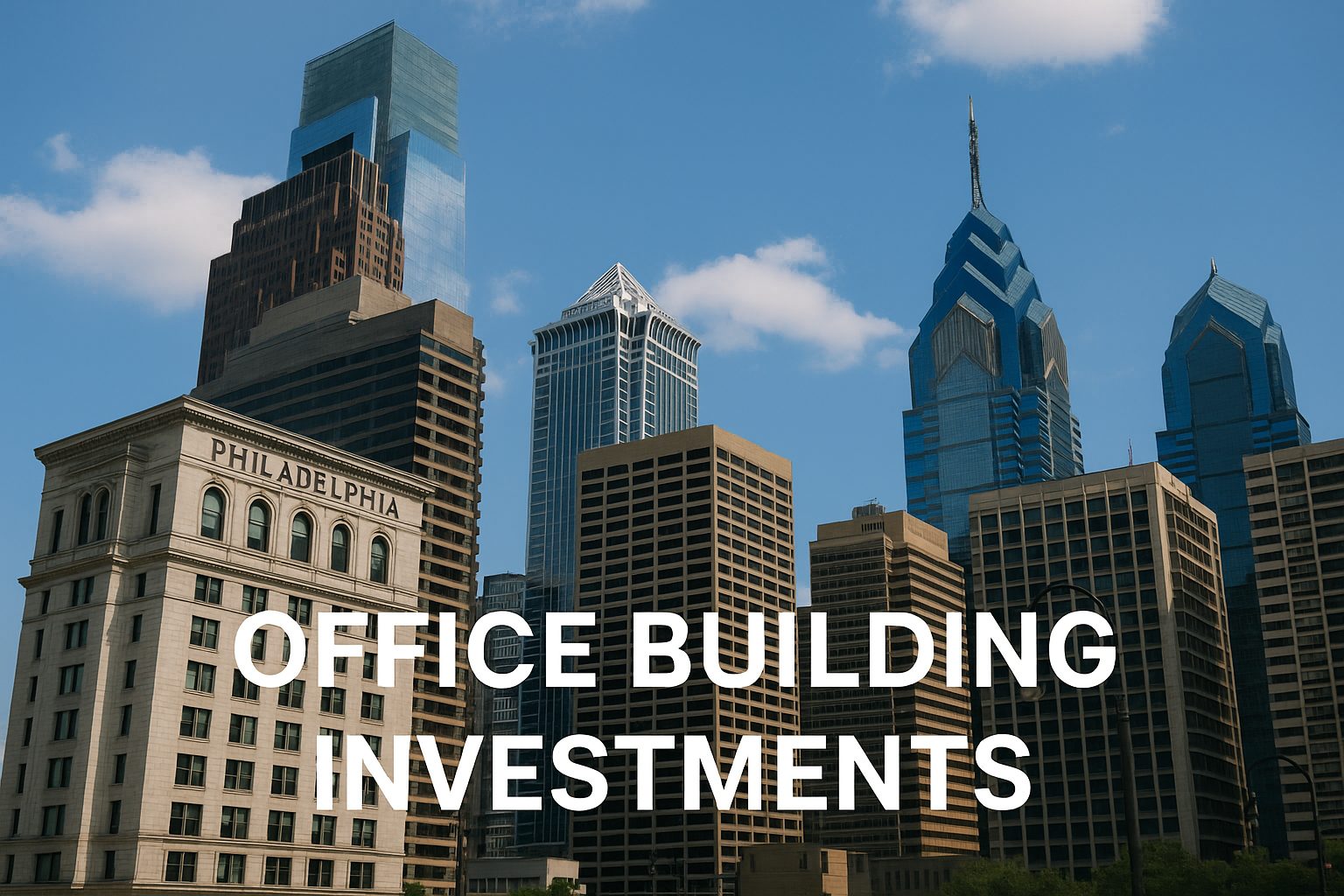
Investing in U.S. Office Buildings:
A 50-Year Analysis of the Road Ahead for Greater Philadelphia
The U.S. office building market, a cornerstone of commercial real estate, is at a pivotal juncture. For investors, the current landscape—shaped by decades of economic cycles, technological revolutions, and the recent, dramatic shock of the COVID-19 pandemic—presents both significant challenges and compelling opportunities.
Key Insight
Office properties purchased before the pandemic were still valued 15% higher on average by mid-2024, demonstrating the resilience of long-term real estate investments despite recent volatility.
This report delves into the 50-year history of office investments, with a special focus on the Greater Philadelphia region, to provide a clear-eyed analysis for investors considering their next move. By understanding the past and present, we can better navigate the future, forecasting trends for 2026 and 2027.
A Half-Century of Office Investment Cycles: Riding the Waves
Office building investments in the United States have always been cyclical. Over the past 50 years, the market has ebbed and flowed with economic tides, construction booms, and financial crises. The key lesson from this history is that while downturns are inevitable, they are always followed by recovery, rewarding patient and strategic investors.
According to the NCREIF Property Index, a key benchmark for institutional real estate, annual total returns for U.S. commercial real estate have been positive in approximately 40 of the last 44 years.
U.S. Office Vacancy Rate Milestones:
| Period (Approx.) | U.S. Office Vacancy Rate | Market Conditions and Events |
|---|---|---|
| Late 1980s – 1991 | ~19% (peak) | Savings & Loan (S&L) crisis and overbuilding led to a glut of space. |
| 2000 (Dot-Com Boom) | ~8% (trough) | The tech boom drove vacancies to a record low of about 7.9%. |
| 2001–2003 (Post-Dot-Com) | ~17% (peak) | A recession and the 9/11 attacks caused a sharp increase in vacancy, peaking around 17%. |
| 2007 (Pre-GFC Peak) | ~12–13% (trough) | A credit boom and economic expansion fueled new development. |
| 2010 (Post-GFC Recession) | ~17% (peak) | The Global Financial Crisis caused demand to contract sharply, with vacancies reaching ~17.2%. |
| 2019 (Expansion Peak) | ~12% (trough) | A decade of economic growth saw vacancies gradually decline. |
| 2023 (Post-COVID Peak) | ~19–20% (record high) | The rise of remote work pushed vacancies to an all-time high of ~19.6%. |
Sources: Moody’s Analytics, FDIC, NCREIF Index data, CNN/Reis vacancy data.
Technology’s Double-Edged Sword: Reshaping Office Demand
Technology has been a relentless force of change in the office sector. From the first personal computers in the 1980s to the cloud computing and collaboration tools of today, innovation has fundamentally altered how and where we work.
Initially, technology like bulky mainframe computers centralized office layouts. However, the advent of PCs, the internet, and Wi-Fi progressively untethered employees from their desks. This led to the rise of open-plan offices, flexible layouts, and eventually, remote work. Companies found they could do more with less space, leading to a gradual decline in the square footage needed per employee.
The COVID-19 Shock: A Catalyst for Change
The COVID-19 pandemic was an unprecedented shock to the office market, acting as a massive accelerator for pre-existing trends.
Pandemic Impact by the Numbers
Remote work tripled from 8-9% pre-pandemic to 32% in 2021, settling at 28% of workdays in 2023. This shift drove office vacancies to record highs of 19.6% nationally.
- Vacancy Rates Skyrocket: As a direct consequence, U.S. office vacancy rates hit a record high of 19.6% in late 2023. Since 2020, tenants have returned roughly 243 million square feet of space to landlords.
- Investor Sentiment Shifts: Publicly traded office REIT indices fell by approximately 37.6% in 2022. Private market values also corrected, with some high-profile buildings trading at 20-30% discounts to pre-pandemic valuations.
- The “Flight to Quality”: A significant trend has emerged—a bifurcation of the market. Newer, high-quality, amenity-rich buildings (Class A) are in high demand, while older, less desirable buildings (Class B/C) are struggling. An estimated 90% of all U.S. office vacancies are in the bottom 30% of buildings by quality.
- Adaptive Reuse on the Rise: To combat high vacancies, cities and developers are increasingly converting obsolete office buildings into apartments, hotels, or life sciences labs. In Philadelphia alone, at least 2.5 million square feet of office space is a candidate for conversion.
Signs of a Rebound: The Path to Recovery
After a challenging few years, the U.S. office market is showing signs of stabilization and is poised for a gradual recovery in 2025 and beyond.
National Indicators
- Positive Absorption: +10.3M sq ft in Q4 2024
- Peaking Vacancy: ~19% expected in 2025
- Construction Slowdown: Only 17M sq ft in 2025
- Prime Vacancy Rates: ~8.2% by 2027
Philadelphia Market
- Positive Absorption: 615K sq ft in 2024
- Metro Vacancy: ~20.5% currently
- University City: 11.5% vacancy
- CBD Vacancy: ~23.0%
The Road Ahead: 2026-2027 Outlook
Looking forward, the office sector will continue to evolve. Investors should anticipate the following trends:
- Hybrid Work as the Standard: Companies will focus on making their office spaces hubs for collaboration and culture, rather than just places for individual work.
- The Upgrade Cycle Continues: As top-tier offices fill up, the focus will shift to upgrading well-located Class B buildings to meet modern tenant demands.
- Demographics Driving Demand: The retirement of Baby Boomers will be offset by the needs of a large Millennial workforce that values in-person collaboration and mentorship. Growth in sectors like healthcare will also fuel office demand.
- A New Capital Market Environment: While financing will likely remain more disciplined than in the past, a stabilization of interest rates could bring more investors back into the market, particularly those looking for value-add opportunities.
Investing in Greater Philadelphia: The Bottom Line
For investors with a long-term perspective, the current office market, particularly in Greater Philadelphia, offers a compelling mix of opportunities and challenges.
Opportunities
- Cyclical Upside: Investing near the bottom of the cycle offers potential for significant returns
- Attractive Pricing: Assets trading below replacement cost
- Value-Add Potential: Older building stock ripe for renovation
- Stable Economic Base: Resilient “Eds and Meds” foundation
Challenges
- Short-Term Uncertainty: Gradual recovery requires patience
- Capital Constraints: Financing remains a hurdle
- Structural Shifts: Careful asset selection is crucial
A recommended strategy for investors is a “barbell” approach: allocate capital to both high-quality, stable assets for immediate cash flow and to underperforming properties that can be repositioned for substantial appreciation.
In conclusion, while the narrative around office real estate has been one of disruption, it is now shifting to one of opportunity. Just as the retail sector reinvented itself in the face of e-commerce, the office sector is undergoing its own transformation. Investors who embrace this change and focus on next-generation assets in resilient markets like Greater Philadelphia are well-positioned to reap significant rewards in the years to come.